Common Parts of a House Exterior

Many homeowners never consider the exterior house terminology associated with their home because they don’t see a need to. However, when it comes to maintaining your home, being able to recognize the common parts of a house exterior could be the difference between ineffective maintenance and safe, successful upkeep.
Different Parts of a House Exterior
While every home is unique, there are several exterior components of a house that are found in most residential homes.
The Roof System
A roof may seem like a simple structure, but it consists of several components that enhance and protect your home. The main structural components of a residential roof are the roof hip and gables. The roof hip forms where sloped roof sides meet, while the gables are the triangular wall sections at the roof’s peak.
Across your roof, you’ll find several features, such as:
- Shingles: Usually rectangular and flat, shingles cover the roof exterior. While delivering a visually appealing finish, the shingles’ primary function is to provide a protective layer that shields your home from the elements.
- Chimney: The most recognizable roof feature, a chimney vents smoke from your fireplace to outside your home. Proper chimney maintenance decreases the risk of a chimney fire and safeguards your home’s interior air quality.
- Vents: Designed to release hot air and moisture from your home, vents help to regulate your home’s temperature and humidity levels. There are various vent types, such as roof, gable and ridge vents.
- Flashing: A weather-resistant barrier, flashing is placed over gaps in your roof, such as around the base of your chimney and underneath shingles. Flashing makes it easier to maintain your home’s climate and improve its energy efficiency.
Maintain your roof through regular roof treatment to ensure it protects your home from weather, drafts, vermin and more.
The Overhang System
Located around the edge of the roof, the overhang system protects the roof while enhancing its appearance. The overhang system typically consists of:
- Eaves: While eaves come in various styles that enhance your home’s appearance in different ways, their main purpose is to protect your home from the weather. Eaves extend beyond the roof edge and distribute the roof’s weight across the width of your home.
- Soffits: Connecting your home’s roofline to its exterior and fitted horizontally, your home’s soffits are beneath the roof’s overhang. Soffits’ primary function is to provide ventilation to your home and seal the eaves, although they also hide your home’s structural elements.
- Fascia: Like soffits, fascia seals your roof against the elements and enhances your home’s appearance, while also holding roof shingles in place. Fascia boards are fitted vertically and provide a strong base to affix your guttering to.
- Gutters: Your home’s gutters carry water from the roof down to ground level to prevent water damage. Water flows to the ground via downspouts, which direct the water away from your home’s foundations and usually into a drainage system, requiring regular gutter cleaning to prevent clogs.
Siding
Regardless of which area of your home’s exterior needs maintenance, siding will likely cover it. Siding protects your home from the elements while providing a key aesthetic element of your home’s exterior.
One of the most common styles is horizontal siding, which places horizontal panels in a “bottom up” configuration. This layout prevents water and dirt from accumulating atop each panel. Vertical siding also uses panels, except the panels run perpendicular to the ground rather than parallel to it. Shingle siding consists of overlapping rows of shingles to deliver a premium finish. Shake siding is similar to shingle siding, except it uses rough-cut shingles to create a textured finish.
Common siding materials include wood, slate, vinyl and fiber cement, with each offering a distinct aesthetic.
Windows and Doors
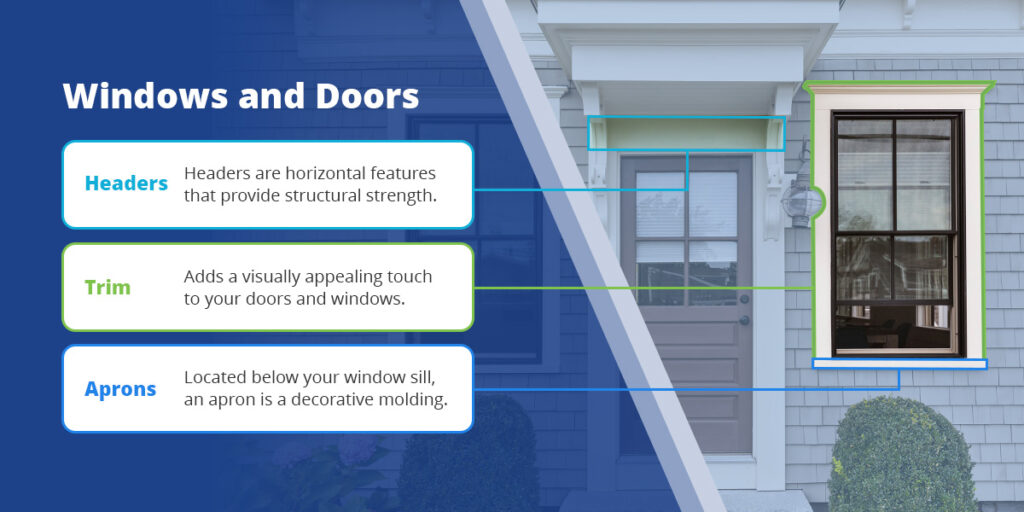
You’ll be familiar with the doors and windows found in your home, but it’s also important to understand how they fit into your exterior. External features commonly found around windows and doors include:
- Trim: While trim adds a visually appealing touch to your doors and windows, it also seals any gaps between these features and your home’s siding. Often made of wood, vinyl or metal, this seal prevents drafts and allows for more control over your home’s interior climate.
- Headers: Found directly above your windows or doors, headers are horizontal features that provide structural strength and aesthetic benefits. Headers often use strong materials such as wood, steel or stone.
- Aprons: Located below your window sill, an apron is a decorative molding. Like trim, it further protects your home against water damage.
Foundation and Ground-Level Elements
At ground level, several larger elements greatly affect your home’s appearance and functionality. Among these features, the foundations are the most important. Usually made of concrete or stone, your home’s foundations must be strong and well-maintained to support its weight.
Additionally, your home’s driveway is often one of the first elements visitors will see when they arrive at your home. Maintaining your driveway is important to enhance its aesthetic appeal and longevity.
Porches are also extremely popular, creating a roofed area that extends from your home’s entrance. They come in various styles, from wrap-around to screened.
How to Ensure Effective Home Exterior Maintenance
Knowing the many house component names and understanding the components is vital to effectively and safely maintaining your home’s exterior. Effective maintenance can increase your home’s value, curb appeal and appearance, all while improving the longevity of its various features.
You should carry out exterior maintenance at least once each year, although different parts of your home’s exterior may need more regular maintenance than others. While maintaining your home’s exterior can involve repairs and part replacement, a large part of maintenance comes down to proper cleaning. You can clean your home’s exterior through:
- Power washing: Much of your home’s exterior can usually be power-washed, allowing for fast and effective treatment, though it depends on a surface’s material and its location.
- Appropriate-pressure washing: More fragile or decorative parts of a home’s exterior, such as windows and patios, may be damaged by pressure washing and require a garden hose with varying nozzles that can tailor the pressure to each area and material.
- Hand scrubbing: Use a sponge, mild dish soap and hot water to clean small, delicate features like window trim, headers and aprons.
Cleaning your roof and other features situated at height can be trickier and more dangerous. The key cleaning tasks here will be to remove debris from your gutters and to use a leaf blower or a broom to clean your roof. However, you should take every safety precaution possible to clean your roof safely.
For the best results and safest maintenance regimen, many homeowners hire an experienced and local professional who is an expert in maintaining the diverse parts of a house exterior.
Professional Home Exterior Maintenance With Perfect Power Wash
Whatever features or materials your home’s exterior consists of, regular and effective maintenance is vital. At Perfect Power Wash, we’ve provided regular maintenance to over 350,000 homes since 2000. What’s more, with over 2,500 five-star reviews on Google, an A+ rating with the BBB, and as an Elite Service member with HomeAdvisor, we’re confident that we can satisfy your home’s exterior maintenance needs.
To find out how one of our local teams can deliver safe and effective home exterior maintenance services, call us today at 833-868-8873 for a free quote.