Common Problems With Holiday Lights and How to Fix Them

Pulling out the holiday lights only to find half the strand dark, or nothing lighting up at all, is one of the most common issues homeowners face. While many failures come from a small handful of predictable, fixable causes rather than a dead strand you need to toss, loose bulbs, blown fuses or overloaded strands can all knock out your display. Fortunately, each problem has a clear diagnosis and fix.
Decorating also carries real safety stakes, sending roughly 14,900 people to emergency departments annually, with about 160 injuries occurring every day during the holiday season. Knowing how to troubleshoot Christmas lights protects both your display and your household.
How to Fix Holiday Lights That Won’t Turn On
When you plug in a strand and nothing happens, work through the possible causes in order rather than guessing:
- Test the outlet: Plug in another device, like a phone charger, to confirm the outlet itself is delivering power.
- Check the circuit breaker: A tripped breaker cuts power to the whole circuit, so reset it if needed.
- Inspect each bulb’s seating: On a series-wired incandescent strand, one loose bulb can interrupt the entire circuit, so press each bulb firmly into its socket.
A strand that’s still completely dark after these steps likely has a blown fuse. Fuses are worth checking first since overcurrent protection is one of the three important safety characteristics that holiday lights should have. From there, fixing a broken Christmas light strand often comes down to a simple fuse swap.
How to Replace a Christmas Light Fuse
Before touching anything, unplug the strand completely, then follow these steps:
- Locate the fuse compartment: Find the small sliding door on the plug body, which houses the fuse.
- Open the compartment: Use a small flathead screwdriver to slide or pry it open.
- Inspect the fuse: A blown fuse typically shows a broken filament or dark, cloudy glass.
- Replace with a matching fuse: Swap in a fuse of the same size and amperage rating. Replacement fuses are often included with the light set, and hardware stores carry them too.
- Close and test: Snap the compartment shut and plug the strand back in.
Never substitute a fuse with a higher amperage rating than the original, even temporarily. For extra guidance, this step-by-step fuse-replacement walk-through covers the same process in more detail.
How to Find a Bad Christmas Light Bulb
Keeping the strand plugged in, run a Christmas light tester along the dark section. The tester signals the moment it reaches the failed bulb, letting you replace and retest that spot alone.
Prefer to check manually? Unplug the strand first, then ensure each bulb in the affected section has a firm seat in its socket, since a loose bulb is a frequent culprit. Finally, look for cloudy or blackened glass.
While LED strands are usually more forgiving, one bad bulb on a series-wired incandescent strand can take out an entire section. You’ll want to consider that difference when choosing the right holiday lights for next season.
How to Fix Flickering Christmas Lights
Flickering usually traces back to one of three causes, so start by ruling out:
- Loose bulbs or connections: Reseat each bulb firmly in the affected section, since a partial connection is the most common cause of flickering.
- An overloaded circuit: Too many strands plugged into one outlet can cause a voltage drop, so reduce the number of strands per outlet and confirm it isn’t shared with other high-draw appliances. Sticking to safe installation practices helps you avoid this problem from the start.
- Moisture or corrosion: Outdoor lights exposed to rain, snow or humidity are prone to this, so inspect plug prongs and bulb sockets for visible corrosion.
If the problem persists after ruling out all three checks, the wiring itself may be damaged and should be replaced. Incandescent bulbs convert about 90% of their energy into heat rather than light, a key reason switching to LEDs reduces many of these voltage-related issues in the first place.
How to Fix a Broken Christmas Light Strand
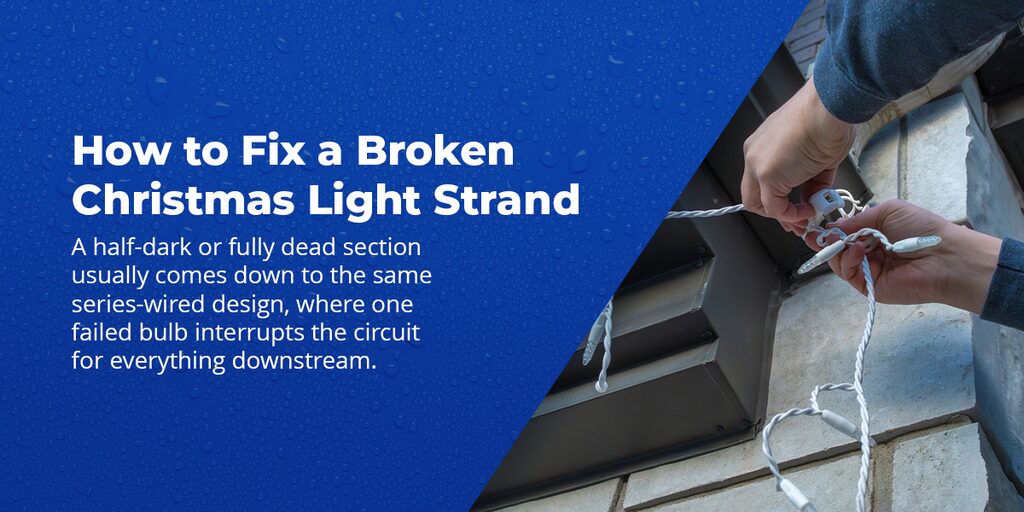
A half-dark or fully dead section usually comes down to the same series-wired design, where one failed bulb interrupts the circuit for everything downstream. Always unplug the strand before handling it. Then isolate the dark section, check each bulb for a firm seat and use a tester, if you have one, to pinpoint the problem bulb for replacement.
Not every strand is worth fixing, though. If the wiring is frayed or cracked, the plug is damaged, or you spot any exposed wires, replace the strand entirely rather than trying to patch it, since damage like this is a recognized fire hazard, not just a performance issue. Making a habit of inspecting your lights before the season starts is the easiest way to catch problems early, whether you’re patching an old strand or learning how to fix Christmas lights for the first time.
How to Prevent Christmas Lights From Overheating
Overheating typically stems from three habits:
- Daisy-chaining too many strands to a single outlet
- Relying on incandescent bulbs that convert about 90% of their energy into heat rather than light
- Leaving a display running continuously for long stretches
A few simple changes can fix the problem. Follow manufacturer guidelines, which typically cap standard strands at three per outlet, and use a timer to limit run time rather than leaving lights on overnight. The biggest improvement, though, comes from upgrading to energy-efficient LED Christmas lights, since LEDs use about 1/6 as much electricity as incandescent bulbs and last up to 20 times longer, generating far less heat in the process.
How to Untangle Christmas Lights
Untangling goes faster when you resist the urge to pull. Lay the strand flat across a large surface, like a floor or table, then use the plug end as your anchor point and work knots loose from there. A pen or pencil can help ease apart stubborn tangles without stressing the wires.
Once untangled, prevent next year’s headache by wrapping each strand around cardboard, a dedicated reel or another cylindrical object, then storing it in a cool, dry place. Improper storage is usually the real culprit behind repeat tangling, and it wears down wiring faster. Making proper holiday light storage a habit is one of the simplest ways to reduce how often you need to repair holiday lights each winter.
Let Perfect Power Wash Handle Your Holiday Lights This Season
Troubleshooting store-bought strands is useful in a pinch, but if you’re ready to skip the annual bulb hunt, professional holiday light installation from Perfect Power Wash uses commercial-grade LED lights with a 10-year lifespan and just a 1% average failure rate. If any of our installed lights go out during the season, our team returns and fixes them at no charge.
We guarantee to deliver the best results possible for your property using our safe and effective processes! Tear-down and storage are included at no extra cost, sparing you the need to even get out your ladder. Read our professional vs. DIY holiday lights breakdown, then call 833-868-8873 to get started.